
CONTACT
  • Login
Upgrade
MAwebzine
Advertisement
  • Home
    • Our Authors
    • MAwebzine Readers Club
    • Media Kit
    • Contact
    • Cookie Policy
    • Terms and Conditions
  • News
  • Lifestyle
    • Beauty
    • Kids
    • Sustainable fashion
    • Interior Decoration
    • Well-being
    • Food
      • Gluten-Free
    • DIY
      • Woodworking
      • Gardening
      • Masonry
      • Mecanics
      • Plumbing
  • Vibes
  • Culture
  • Sports
  • Travels
  • Business
  • World
  • Local Guide
    • Activities in Morocco
    • Hotels in Morocco
    • Nightlife in Morocco
    • Restaurants in Morocco
    • Services in Morocco
    • Shopping in Morocco
  • APP
  • Home
    • Our Authors
    • MAwebzine Readers Club
    • Media Kit
    • Contact
    • Cookie Policy
    • Terms and Conditions
  • News
  • Lifestyle
    • Beauty
    • Kids
    • Sustainable fashion
    • Interior Decoration
    • Well-being
    • Food
      • Gluten-Free
    • DIY
      • Woodworking
      • Gardening
      • Masonry
      • Mecanics
      • Plumbing
  • Vibes
  • Culture
  • Sports
  • Travels
  • Business
  • World
  • Local Guide
    • Activities in Morocco
    • Hotels in Morocco
    • Nightlife in Morocco
    • Restaurants in Morocco
    • Services in Morocco
    • Shopping in Morocco
  • APP
No Result
View All Result
MAwebzine
No Result
View All Result
Home Travels

The Generosity of a Amazigh Family to Marie

The touching story of Marie, a Belgian photographer welcomed by a Amazigh family in Morocco. Discover how this encounter changed her life forever and beyond.

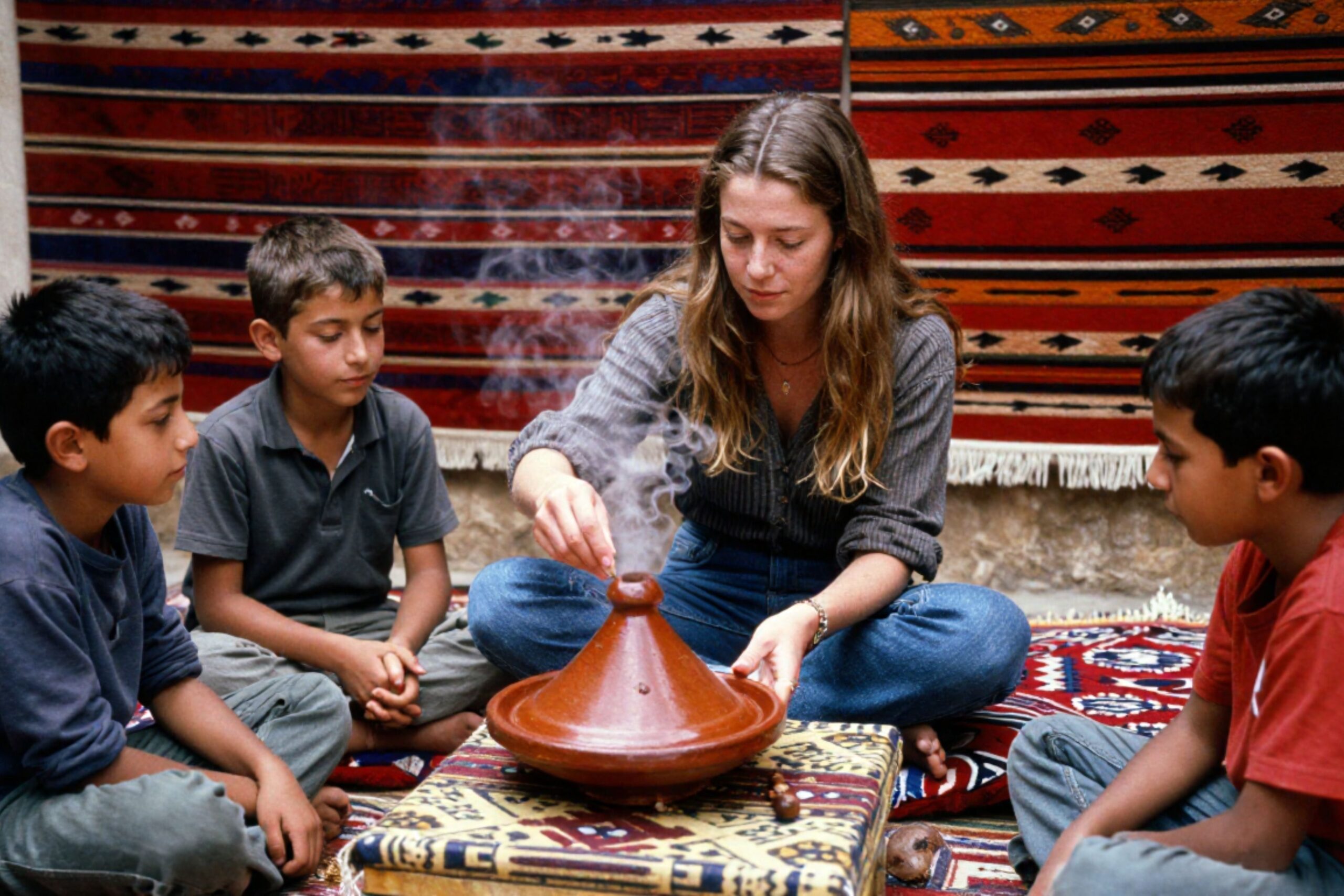
Amazigh Hospitality - young belgian woman sharing tagine with young Amazigh boys

My name is Marie, I’m thirty-two years old, and I work as a freelance photographer in Brussels. Between deadlines and daily stress, I was suffocating in my routine. A year ago, I decided to travel alone to Morocco to experience authentic Amazigh hospitality firsthand. In the Atlas Mountains, an Amazigh family opened their door and their heart to me. This unexpected encounter with traditional Amazigh hospitality transformed my vision of the world. I discovered that true Amazigh hospitality doesn’t need material wealth, and that the most beautiful experiences happen when you least expect them.

My First Experience of Amazigh Hospitality

It was my third day in Morocco, and I had ventured into the Ourika Valley, hoping to witness the renowned Amazigh hospitality I’d heard so much about. The autumn colors were breathtaking – golden walnut leaves against an intense blue sky. I was so absorbed in my photography that I lost track of time completely.

When I finally looked at my watch, it was already five o’clock. The sun was descending behind the peaks, and panic set in. I had wandered much farther than planned, my phone had no signal, and I didn’t know exactly where I was. Little did I know that I was about to experience Amazigh hospitality in its purest form.

I quickened my pace, trying to retrace my steps, when I spotted a traditional pisé house nestled below. The earthen walls seemed to grow from the landscape itself. A man stood at the door, and when he saw me, he raised his hand in a welcoming wave – the first gesture of Amazigh hospitality I would receive that day.

His smile was so warm and genuine that my fears melted away. He pointed to the setting sun, then to his house, making the universal gesture for “come eat.” This is the essence of Amazigh hospitality – welcoming strangers without hesitation. I hesitated for only a moment before following him inside.

Food

Warm Spice Blends to Use in Moroccan Cooking

15/09/2025

The Warmth of Amazigh Hospitality Traditions

Stepping into that house felt like entering another world. The earthen floor gleamed, colorful Amazigh rugs covered the living room, and soft light filtered through small windows. The entire family appeared to greet me.

The mother took my hands in hers. She spoke in Tamazight, words I couldn’t understand, but her warmth brought tears to my eyes. Three young boys emerged. 

Install the MAwebzine App
Always stay up to date with the latest news from Morocco.
Install now →

“Sit down, sit down,” the mother said, guiding me to plush cushions. Minutes later, she returned with a copper tray bearing a steaming teapot and decorated glasses. I watched in awe as she poured mint tea from high above, creating perfect foam.

“The foam is important,” the eldest son explained in French. “It shows the tea is prepared with love.” The children gathered around as I showed them photos on my camera. Their faces lit up with each image, touching the screen as if it were magical.


-

Pink Damascus rose fields in full bloom in the Valley of Roses near Kelaat M'Gouna, Morocco during the annual Rose Festival

Morocco Rose Festival 2026: Kelaat M’Gouna Guide

07/05/2026
Bright blue modern house with yellow window curtains, set among tall cacti and palm trees against a clear sky.

Marrakech Morocco 2026: 6 Hidden Garden Gems

09/04/2026
Spring day trips taking tourists to Essaouira coastal destination from Marrakech Morocco

Morocco Spring 2026: 7 Best Day Trips from Marrakech

19/03/2026
Blue city Chefchaouen Morocco featuring iconic blue painted streets for photography and Instagram spots

Chefchaouen Blue City: Photography Guide and Hidden Instagram Spots

01/02/2026
Atlas Mountains hiking in winter with snow-covered peaks and trekking routes in Morocco

Atlas Mountains Hiking: Winter Guide 2026

18/01/2026
Souk negotiation Moroccan merchant smiling customer market stall

Souk Negotiation: Master Bargaining in Morocco

21/12/2025

The father sat beside me, telling me in broken French that his family had lived here for four generations. The grandmother appeared, elderly but with sparkling eyes, and took my hand. She didn’t speak French, but her comforting presence needed no words.

What touched me most was how natural my presence seemed to them. No suspicion, no uncomfortable questions – just pure, uncomplicated generosity.


Funny Personalized Products Morocco 1

Amazigh Hospitality in the Kitchen

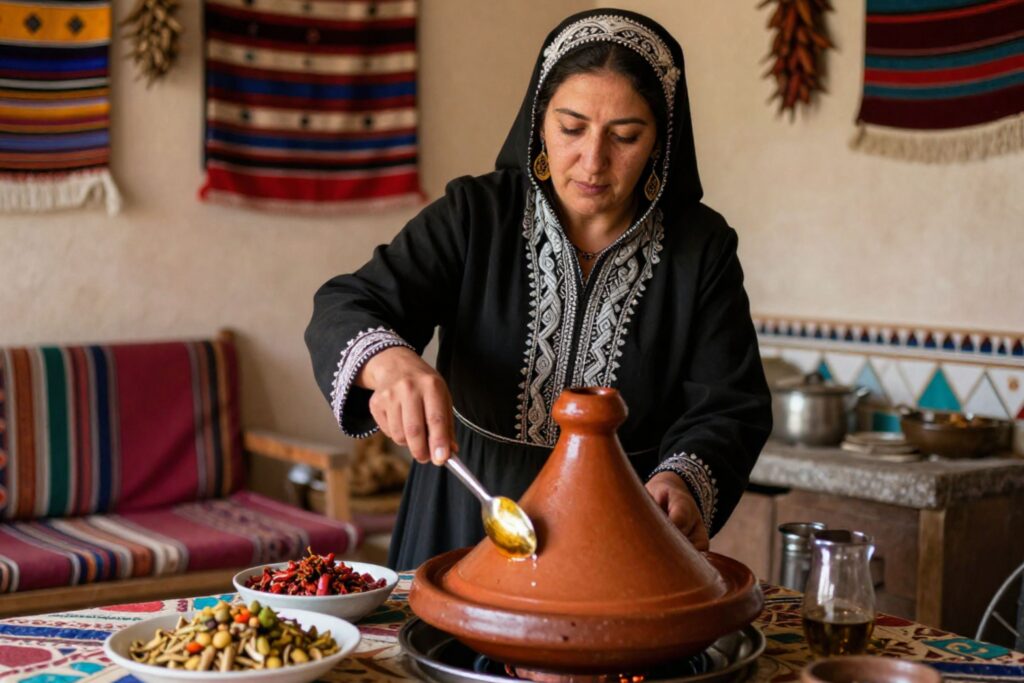
As evening fell, the mother beckoned me to follow her to the kitchen, where I would witness the culinary aspect of Amazigh hospitality. It was simple but full of life – an earthen oven, copper pots, shelves of spices in glass jars. The grandmother was already there, peeling vegetables with remarkable speed despite her age.

I offered to help, but she laughed and shook her head, signaling me to watch. In Amazigh hospitality culture, guests are never expected to work. I observed her prepare a tagine, sautéing onions in olive oil before adding spices. The aroma was intoxicating – cumin, saffron, ginger, coriander blending in perfect harmony, creating the flavors that make Amazigh hospitality cuisine so memorable.

“It’s my mother’s recipe,” the mom explained through her elder son’s translation. “Seven-vegetable tagine. Each vegetable has meaning. Together, they represent family harmony – a core value in Amazigh hospitality.” This meal preparation was more than cooking; it was a demonstration of how deeply Amazigh hospitality is woven into daily life.

She showed me the vegetables from their garden – carrots, zucchini, turnips, pumpkin, tomatoes, peppers, and potatoes. Everything was grown by their own hands, cultivated with care and love. This self-sufficiency is another beautiful aspect of traditional Amazigh hospitality – sharing what the land provides.

The grandmother added each ingredient with the precision of an artist. This wasn’t just cooking – it was a ritual, a meditation, a way of showing love through Amazigh hospitality. I felt privileged to witness this intimate moment and understand how Amazigh hospitality traditions are preserved through these everyday practices.

Expats exploring a colorful medina street during their first weeks of moving to Morocco

Moving to Morocco: What Expats Should Know

31/05/2026

Moving to Morocco is one of the most rewarding decisions an expat can make. The country offers rich culture, warm...

Noor Ouarzazate solar complex in Morocco representing the renewable energy pillar of the Morocco green economy

Morocco Green Economy: 5 Sectors Leading Change

28/05/2026

Morocco is redefining what economic growth looks like in Africa. The Morocco green economy is no longer a long-term ambition....

Royal Mansour Academy hospitality training program launch in Rabat Morocco

Royal Mansour Academy Opens 2026 Enrollment

25/05/2026

Royal Mansour Academy is now opened in Rabat  and enrollment for the 2026–2027, academic year is available till September 2026....

Moroccan families selecting sheep at a traditional livestock market ahead of Eid al-Adha Morocco 2026

Eid al-Adha 2026: Morocco’s 5 Economic Traditions

17/05/2026

Every year, one holiday reshapes the entire Moroccan economy for several weeks. Eid al-Adha Morocco 2026 is expected on Wednesday,...

The Heart of Amazigh Hospitality: Sharing a Meal

An hour later, we sat in a circle around the steaming tagine on a low table. The father said a prayer in Tamazight, and we began eating with fresh bread – no utensils needed. This communal eating style is fundamental to Amazigh hospitality, creating bonds between all who share the meal.

My first attempts were disastrous. The bread broke, vegetables slipped away. The children laughed joyfully – never mockingly – and the elder son demonstrated the technique. “Like this, you see? You pinch with the bread.” Their patience with me reflected the gentle nature of Amazigh hospitality.

The grandmother barely ate. She kept placing the best pieces in front of me, shaking her head firmly whenever I protested. “Eat, eat,” the mother insisted. “You are our guest.” This generosity toward guests is perhaps the most recognizable trait of Amazigh hospitality – the best portions always go to visitors.

Between bites, the father shared his life story, explaining how Amazigh hospitality had always been central to their family values. He’d worked the land since age ten, built additions to the house stone by stone for his children, and hoped his sons would continue practicing the same Amazigh hospitality traditions. “Life is simple here,” he said. “We don’t have much money, but Amazigh hospitality teaches us we have everything we need. The land feeds us, family makes us happy.”

The children bombarded me with questions about Belgium, my life, my travels. I told them about my photography dreams, my need to discover the world. “You’re lucky,” the eldest son said. “I dream of traveling someday too, and I hope to share Amazigh hospitality with visitors wherever I go.”

The meal stretched for hours. We laughed, shared stories, created bonds that transcended language – all expressions of authentic Amazigh hospitality. At one point, the little boy fell asleep against me, and the mother carried him away with a tender smile.

When we finished, the grandmother brought oranges and dates. “For digestion,” the daughter explained. We sipped more mint tea, this time prepared by the children showing off their skills in the art of Amazigh hospitality that they were learning from their elders.

Amazigh Hospitality - woman preparing tagine

A Farewell That Embodies Amazigh Hospitality

The next morning, I woke in the girls’ room – they’d given me their bed and slept with their mother. This selfless act was yet another example of Amazigh hospitality putting guests’ comfort above their own. The scent of cooking msemen filled the air.

In the kitchen, the mother had prepared a farewell feast: hot msemen, eucalyptus honey, argan butter, olives, goat cheese. “You must eat well before leaving,” she insisted. Even in goodbye, Amazigh hospitality remained unwavering – ensuring I was well-nourished for my journey ahead.

The whole family gathered for one last breakfast together. My heart grew heavier with each passing moment. How could I say goodbye to people who had shown me the true meaning of Amazigh hospitality and become family overnight?

When I stood to leave, the mother returned with a basket overflowing with provisions – bread, fruit, cheese, even argan oil. “For your journey,” she said softly. This final act of Amazigh hospitality brought tears to my eyes.

I tried to refuse, to give them money, but the father shook his head firmly. “You are our sister now,” he declared. “Brothers and sisters don’t pay each other. This is the way of Amazigh hospitality.” In their culture, once you’ve shared a meal and a roof, you’re family – and Amazigh hospitality to family requires no payment.

Tears streamed down my face. The grandmother embraced me, kissing my forehead in a gesture of Amazigh hospitality that felt like a blessing. The children made me promise to return and experience their Amazigh hospitality again. The daughter removed her Amazigh bracelet and pressed it into my palm. “So you’ll remember us and our Amazigh hospitality traditions,” she whispered.

Gardening

How to grow a lemon tree from a seed?

03/02/2025

Conclusion

I walked away on the mountain trail, turning back constantly to see them waving until I disappeared around the bend. That basket in my hands and my overflowing heart were the greatest treasures I’d ever received – gifts of authentic Amazigh hospitality that money cannot buy.

That single night with this Amazigh family changed something fundamental in me. I learned that true Amazigh hospitality expects nothing in return. That this ancient tradition of Amazigh hospitality isn’t about material means but about the size of one’s heart. That despite our different languages and cultures, Amazigh hospitality creates connections that transcend all barriers.

A year later, I still wear that bracelet every day as a reminder of the extraordinary Amazigh hospitality I experienced. I think of them constantly. Their example of authentic Amazigh hospitality guides my actions now. I try to be more generous, more open, more welcoming to strangers in my own life, hoping to bring a little bit of that Amazigh hospitality spirit into my world.

I’ve realized that if each of us could embrace the spirit of Amazigh hospitality – opening our doors and hearts without hesitation, without expectation, with pure kindness – the world would be transformed. The Amazigh people have preserved these traditions of hospitality for centuries, and they taught me that the greatest wealth isn’t what we own, but what we’re willing to share. Amazigh hospitality is more than a cultural practice; it’s a philosophy of life that the world desperately needs. And that lesson is one I’ll carry with me forever.

Learn more about Amazigh culture in Morocco

  1. Visit Morocco – Official Tourism Website
  2. Amazigh traditions recognized by UNESCO
  3. Discover Atlas Mountains communities
author avatar
MAwebzine
MAwebzine is a multilingual online magazine of and managed by the communications agency NOOR & NOOR, and offers a wide range of news, insights, tips, and more from Morocco. It caters to Moroccans as well as anyone with a love for Morocco.
See Full Bio
Tags: Amazightestimonial
Previous Post

Winter Skincare in Morocco: Dry Climate Protection

Next Post

A Gluten-Free Breakfast in Morocco: Healthy Starts

Related Posts

Pink Damascus rose fields in full bloom in the Valley of Roses near Kelaat M'Gouna, Morocco during the annual Rose Festival
Travels

Morocco Rose Festival 2026: Kelaat M’Gouna Guide

07/05/2026
Bright blue modern house with yellow window curtains, set among tall cacti and palm trees against a clear sky.
Travels

Marrakech Morocco 2026: 6 Hidden Garden Gems

09/04/2026
Spring day trips taking tourists to Essaouira coastal destination from Marrakech Morocco
Travels

Morocco Spring 2026: 7 Best Day Trips from Marrakech

19/03/2026
Blue city Chefchaouen Morocco featuring iconic blue painted streets for photography and Instagram spots
Travels

Chefchaouen Blue City: Photography Guide and Hidden Instagram Spots

01/02/2026
Atlas Mountains hiking in winter with snow-covered peaks and trekking routes in Morocco
Travels

Atlas Mountains Hiking: Winter Guide 2026

18/01/2026
Next Post
Traditional Moroccan shakshuka with poached eggs in spiced tomato sauce served in tagine, representing healthy naturally gluten-free breakfast option perfect for health-conscious diners

A Gluten-Free Breakfast in Morocco: Healthy Starts

Comments 7

  1. ZAKTONI HASSAN says:
    6 months ago

    قصة مؤثرة جداً ومفعمة بالدفء! هذه هي الضيافة المغربية الأصيلة بأبهى صورها، والتي تتجلى بصفة خاصة في مجتمعاتنا الأمازيغية.

    المغزى العميق ليس في تقديم الطعام والمأوى فحسب، بل في مفهوم “أنتِ أختنا الآن”. هذا التحول من غريبة إلى فرد من العائلة، والرفض القاطع للمقابل المادي، هو جوهر الكرم الأمازيغي الذي يضع الروابط الإنسانية فوق كل اعتبار. هذه الروح هي الكنز الحقيقي للمغرب.

    Reply
  2. Ahmed Agadir says:
    4 months ago

    الكرم الأمازيغي ليس مجرد تقليد، بل روح تُعاش بكل التفاصيل — من ترحيب دافئ على الباب إلى مشاركة الطاجين على الأرض والابتسامة الصادقة. هذه القصة تذكّرنا بأن القلب الكبير يفتح البيوت قبل الأبواب.

    Reply
  3. Ahmed Agadir says:
    4 months ago

    La générosité amazighe, telle qu’elle est racontée dans ce récit, va bien au-delà de l’hospitalité matérielle. C’est une façon de vivre où l’on reçoit l’étranger comme un membre de la famille, avec chaleur, simplicité et authenticité

    Reply
  4. Ahmed Agadir says:
    4 months ago

    أحيانًا لا يحتاج القلب إلى كلمات ليفهم معنى الضيافة، بل إلى لحظة صمت حول طاولة مشتركة، حيث تُقدّم الخبز والدفء والاحترام قبل أي شيء آخر. ما علّمته هذه العائلة الأمازيغية هو أن الكرم الحقيقي يبدأ عندما نشارك اللحظة أكثر مما نشارك الطعام.

    Reply
  5. Ahmed Agadir says:
    4 months ago

    Ce n’est pas seulement une histoire de repas partagé, mais une leçon de vie. Quand une famille qui n’a que peu de biens matériels t’ouvre grand son cœur, on comprend que la vraie richesse se trouve dans la capacité à donner sans attendre en retour.

    Reply
  6. AlejandroES says:
    2 months ago

    Qué historia tan conmovedora. La hospitalidad amazigh no es solo una tradición, es una lección de vida sobre la generosidad pura y el corazón humano. Me encanta ver cómo estos valores de nuestra tierra siguen impactando al mundo de una forma tan profunda. ¡Orgulloso de nuestra esencia! 🇲🇦✨

    Reply
  7. thomas says:
    2 months ago

    Un récit extrêmement touchant qui illustre parfaitement la légendaire hospitalité marocaine. La générosité des familles amazighes n’est pas seulement une tradition, c’est un véritable art de vivre et une leçon d’humanité. Cet article nous rappelle que la vraie richesse de notre pays réside dans le cœur de ses habitants et leur accueil chaleureux. Merci de partager ces moments d’authenticité qui font la fierté de notre culture

    Reply

Leave a Reply Cancel reply

Your email address will not be published. Required fields are marked *

No Result
View All Result

Our Focus

MAwebzine is your international window on Morocco: lifestyle, business, culture, sports and events for a global audience drawn to the kingdom's rich heritage and modern ambition.

Our Readers

MAwebzine addresses readers who engage with Morocco at a high level: professionally, financially, strategically, and as decision-makers in their fields.

Our Approach

Lifestyle, culture, and investment are integrated as context and indicators of economic transformation, regional positioning, and Morocco's growing international profile, not standalone entertainment.

Recent Post

  • Moroccan tagine: 8 dishes to try
  • Mint tea: 6 best ceremonial tea rooms

© 2026 MAwebzine by NOOR & NOOR — part of WEBZINE.world.

Welcome Back!

Login to your account below

Forgotten Password?

Retrieve your password

Please enter your username or email address to reset your password.

Log In
Manage Consent
To provide the best experiences, we use technologies like cookies to store and/or access device information. Consenting to these technologies will allow us to process data such as browsing behavior or unique IDs on this site. Not consenting or withdrawing consent, may adversely affect certain features and functions.
Functional Always active
The technical storage or access is strictly necessary for the legitimate purpose of enabling the use of a specific service explicitly requested by the subscriber or user, or for the sole purpose of carrying out the transmission of a communication over an electronic communications network.
Preferences
The technical storage or access is necessary for the legitimate purpose of storing preferences that are not requested by the subscriber or user.
Statistics
The technical storage or access that is used exclusively for statistical purposes. The technical storage or access that is used exclusively for anonymous statistical purposes. Without a subpoena, voluntary compliance on the part of your Internet Service Provider, or additional records from a third party, information stored or retrieved for this purpose alone cannot usually be used to identify you.
Marketing
The technical storage or access is required to create user profiles to send advertising, or to track the user on a website or across several websites for similar marketing purposes.
  • Manage options
  • Manage services
  • Manage {vendor_count} vendors
  • Read more about these purposes
View preferences
  • {title}
  • {title}
  • {title}
No Result
View All Result
  • Home
    • Our Authors
    • MAwebzine Readers Club
    • Media Kit
    • Contact
    • Cookie Policy
    • Terms and Conditions
  • News
  • Lifestyle
    • Beauty
    • Kids
    • Sustainable fashion
    • Interior Decoration
    • Well-being
    • Food
      • Gluten-Free
    • DIY
      • Woodworking
      • Gardening
      • Masonry
      • Mecanics
      • Plumbing
  • Vibes
  • Culture
  • Sports
  • Travels
  • Business
  • World
  • Local Guide
    • Activities in Morocco
    • Hotels in Morocco
    • Nightlife in Morocco
    • Restaurants in Morocco
    • Services in Morocco
    • Shopping in Morocco
  • APP

© 2026 MAwebzine by NOOR & NOOR — part of WEBZINE.world.

MAwebzine Readers Club

Join the MAwebzine Readers Club!

Read and comment on our blogs, collect Stars and receive gifts from our partners. 

More Info
Register
Log In
Are you sure want to unlock this post?
Unlock left : 0
Are you sure want to cancel subscription?
Verified by MonsterInsights
enEnglisharالعربيةdeDeutschesEspañolfrFrançaisnlNederlands