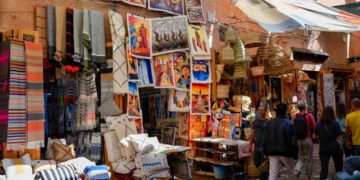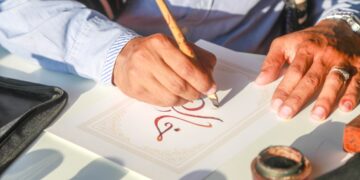


Moroccan mosaic pulls you in before you understand why. You stand in a riad courtyard or a madrasa corridor, and the walls hold you still. Stars, hexagons, and interlocking polygons repeat outward in every direction, and your mind, for a moment, simply rests. That stillness is not accidental.
The art that geometry built
Zellige, pronounced “zellij,” comes from the Arabic word *zulayjah*, meaning “small polished stone.” The name tells you something important: this art begins with material. Clay from the region around Fez, known for its particular density and quality, forms the base of every piece.

The art originated in the 9th century in Fez, influenced by Andalusian and Islamic artistry, where geometry became the primary language of design. It allowed artisans to express harmony, spirituality, and precision without depicting living beings, which Islamic tradition discouraged. So the artists turned to mathematics instead, and found something richer.
Zellige is governed by tessellation: geometric shapes that cover a surface completely without gaps or overlaps. The patterns are infinitely extensible. In theory, the design never has to end. This mathematical infinity is a deliberate expression of a philosophical idea: the infinite nature of the divine.
How a maallem works
The craftsmen behind this ancient art are known as maallems. A maallem will spend years learning their craft, which is passed down from generation to generation. Most begin as apprentices in childhood, absorbing technique through observation before a single tile is cut.
It all begins with the extraction of a special clay in the region of Salé, which has unique properties that give zellige its characteristic strength and beauty. This clay is kneaded and shaped into slabs, then fired for the first time in traditional kilns at 900 degrees. This step transforms the clay into “fakhkhar,” a terracotta base ready to be shaped.
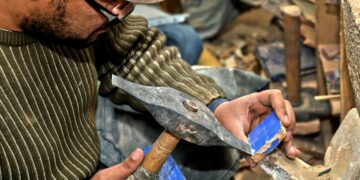
Then comes the most active phase: hand cutting. Artisans use a traditional tool called the “menqach” to cut each tessera with millimetric precision. Despite the entirely manual process, each piece perfectly respects the required dimensions. There is no machine involved. This geometric work happens without computer drawings or modern tools. Only eye and hand work together, from memory and experience.
Why repetition becomes meditation
Neuroscience shows that the brain is wired for pattern recognition. When we encounter repeated symmetrical designs like those in zellige, it activates areas associated with attention, pleasure, and flow. The result is a balance between stimulation and calm: mental activity without mental overload.
This is why zellige often appears in spaces meant for reflection: mosques, madrasas, and courtyards. It helps induce a meditative state, not by eliminating complexity, but by channeling it into harmony. For the maallem, the process works the same way. Cutting 300 or 400 identical pieces in a single session requires the kind of focus that empties the mind of everything else.
Islamic geometric patterns were used as a form of contemplative meditation. The complexity draws the eye inward and creates a sense of infinite, harmonious order. Looking at a perfectly executed zellige panel is supposed to bring you closer to an understanding of divine perfection. The artist and the observer arrive at the same destination through different doors.

Expert perspective on zellige as living heritage
Zellige is not simply a decorative element you place on a wall and admire. It is a system of knowledge that lives inside the hands of the people who make it. The maallem does not follow a printed plan. He carries the geometry in his body, in the angle of his wrist, in the pressure of his hammer. Every cut is a decision made in a fraction of a second, guided by years of practice. When that knowledge is not transmitted to a new generation, it disappears permanently. No photograph or archive can replace what a master holds in his hands. The meditative quality people feel when they look at zellige is real, and it is inseparable from the discipline the artist practices every single day in the workshop.
Industry perspective, craft preservation and cultural heritage professionals in Morocco





Where Fez leads the world
While mass production exists, the true art of zellige thrives in traditional workshops, particularly in Fez and Meknes. Master artisans continue to pass down their knowledge to apprentices, ensuring that this demanding and beautiful art form endures.
The sound of zellige cutting, the rhythmic tapping of hammer on tile, is the soundtrack of the Fez medina. Walk through the craftsmen’s quarter known as Henna al-Majdoul and you will hear it from every workshop. These are not museum demonstrations. The maallems work here every day to fill orders for riads, hotels, mosques, and private homes across the world.
The Zellige de Fès mark is an official designation guaranteeing that the product was handmade by artisans in Fez using natural clay from the region, traditional techniques, and mineral glazes. It matters because cheaper machine-made imitations now fill global markets, and the difference in quality, and in meaning, is vast.

A practice under pressure
The number of young Moroccans entering zellige training has fallen sharply. Machine-made competition undermines the economic case for authentic production. When a maallem retires without successors, the specific patterns, techniques, and shortcuts he carried in his memory are gone permanently. They were never written down.
Morocco’s Ministry of Youth, Culture, and Communication officially launched a project aimed at inscribing the art of zellige from Fez and Tetouan on UNESCO’s Representative List of the Intangible Cultural Heritage of Humanity. Presented during a study day in Salé, the project reflects Morocco’s commitment to preserving this ancestral art form and ensuring its transmission to future generations.
In July 2025, Morocco signed a memorandum of understanding with the World Intellectual Property Organization, and the government stated that zellige was among the heritage elements already registered through WIPO-related mechanisms for stronger legal safeguarding. The art is worth fighting for, in workshops and in international law.
Moroccan mosaic as a model for creative practice
Moroccan mosaic teaches something that goes beyond tilework. It shows that repetition is not monotony. Repetition, practiced with full attention, becomes a method. The maallem does not grow tired of the same cut because each cut demands the same presence as the first.
Zellige is a thousand-year conversation between patience, mathematics, and beauty. It represents the best of Moroccan culture: deep skill passed through generations, infinite complexity hiding behind apparent simplicity, and a commitment to craft that refuses to compromise.

If you want to understand Moroccan mosaic on its own terms, go to Fez. Visit the Henna al-Majdoul quarter. Watch a maallem work. Then stand in front of a finished panel and let your eyes follow the geometry outward. You will feel exactly why this art has lasted for more than a thousand years, and why it deserves to last for a thousand more.
Discover more about Moroccan mosaic
- Morocco UNESCO Intangible Cultural Heritage List
- Morocco Officially Launches Project to Inscribe Zellige on UNESCO Heritage List
- Morocco Moves to Defend Zellige as Algeria’s UNESCO File Draws Scrutiny